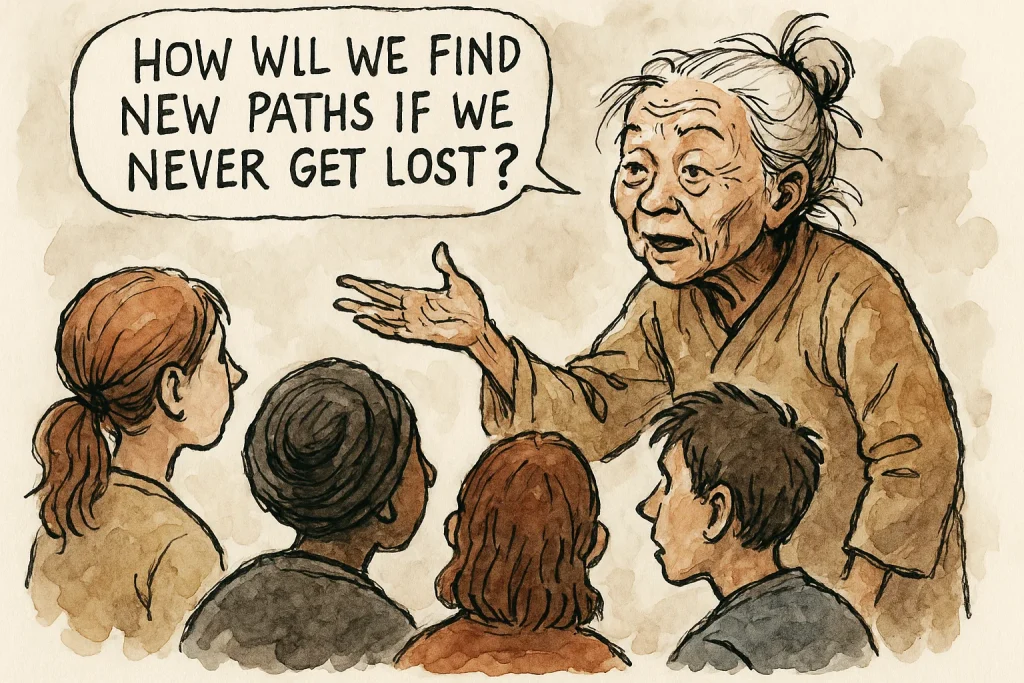
Most of us were trained to avoid any deviation. Plan everything, follow the map, reduce risk. It sounds sensible. The problem is that known routes lead to the same destinations as always. New paths emerge when we allow ourselves to step off the line, explore, test, fail, and return with something that wasn’t on the itinerary. Getting “lost,” here, isn’t irresponsibility – it’s curiosity with a method.
Why Does This Matter?
Because without exposure to the unknown, there is no better alternative – only disguised repetition. The kind of innovation that truly improves life – yours or your client’s – arises when you venture into territories where the map isn’t ready and come back with a practice that becomes part of your routine.
Where Getting “Lost” Makes a Difference
- Career: experimenting with a project outside your role can reveal abilities you didn’t know you had.
- Business: talking to customers who have never bought from you may reveal unexpected uses for your product.
- Learning: studying an adjacent topic (design, writing, finance) changes how you see your own work.
- City: walking down unfamiliar streets exposes opportunities – a missing store, a service no one offers.
The Fear That Blocks Discovery
We fear looking amateurish, wasting time, or admitting we don’t know. Yet the pursuit of total control creates a side effect: repetition. You start optimizing the same answer when what you really need is to formulate a new question.
How to Get “Lost” Without Losing Direction
- Define an Exploration Margin
Set aside 10-20% of your time to test things outside your routine. It doesn’t have to be big – one morning a week is enough. - Trade Certainties for Hypotheses
Write down what you believe (“customers buy based on price”) and create a simple test to challenge it (“offer a value-added package and measure adoption”). - Do Micro-Expeditions
Meet someone from another area, visit a customer who has never complained or praised, or show a prototype to five people. Small, fast, measurable. - Record Findings and Surprises
What did you not expect to see? What words did the customer use? What patterns repeated? Without notes, discovery turns into vague memory. - Return With Something Concrete
Bring back an improvement in communication, one less step in a process, or a new service package. Exploring without integrating is intellectual tourism.
Practical Examples
- Local service: instead of lowering prices, talk to ten clients to learn why they delay payment. Discover that the pickup schedule is inconvenient and adjust routes. Default drops without a price war.
- Freelancer: test a short workshop instead of offering only long consulting engagements. Discover demand for entry-level formats that lead to bigger contracts.
- Team: replace the weekly meeting with a visible task board and a 15-minute check-in. Communication improves because problems surface earlier.
A 14-Day Roadmap
- Days 1-2: list three beliefs you have about your work.
- Days 3-5: create a small test for each belief (a new offer, an interview, a simple landing page).
- Days 6-10: run the test and collect signals (conversion, interest, objections).
- Days 11-12: choose one finding to actually implement.
- Days 13-14: document what changed and plan the next cycle.
Signs You’re on the Right Track
- You have recent stories of something that didn’t work but produced a useful lesson.
- Your vocabulary about the customer has become more specific.
- New alternatives have appeared that you hadn’t considered a month ago.
- Some routine has been simplified based on what you observed in the field.
Conclusion
New paths don’t come from perfectionism; they come from controlled incursions into the unknown. Give yourself permission to get a little “lost” – with limited time, clear tests, and a required return with something useful. Those who only follow the map arrive where everyone already is. Those who explore carefully find routes that, tomorrow, will seem obvious to everyone else.